To see all of our friends and colleagues again after two years is really wonderful – I guess I hope that, after all the organizing in the past weeks, the actual conference will just proceed effortlessly – and, of course, that I can find the time to enjoy some of the papers. But the Pynchon crowd is an easy-going one anyways, so the chances are quite high!
[My most favorite Pynchon novel …] is still Gravity’s Rainbow, my first love, and most Pynchonites would probably say that. The humor, the complexity, the madness of it all in a text, I swear, keeps changing with every re-reading – that’s just exactly what I love about reading.
The International Pynchon Week 2026 in Dortmund
Firstly, there are no breakout panels at IPW events. Everybody presents in plenary form to everybody else for the same length of time. Ph.D. or MA students present for 20 minutes alongside the most revered scholars in the discipline. The event is extremely democratic and non-hierarchical on this front.
Secondly, the events have always been free to attend […], which makes a difference from the hundreds of pounds that are often asked by organizers (sometimes for reasons beyond their control).
Thirdly, and finally, there is a true culture of interest and comradeship. This is not a job scum event. People attend because they are interested in innovative thinking and startling new finds on Thomas Pynchon, not because they want to flatter the right people in the field.
Martin Paul Eve 2013
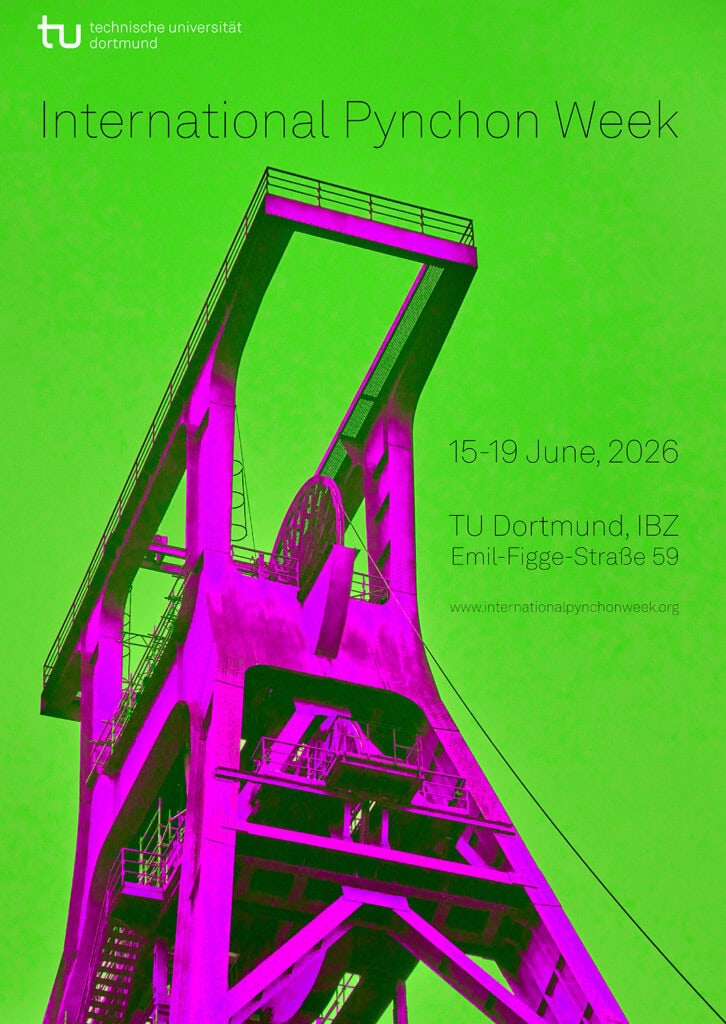
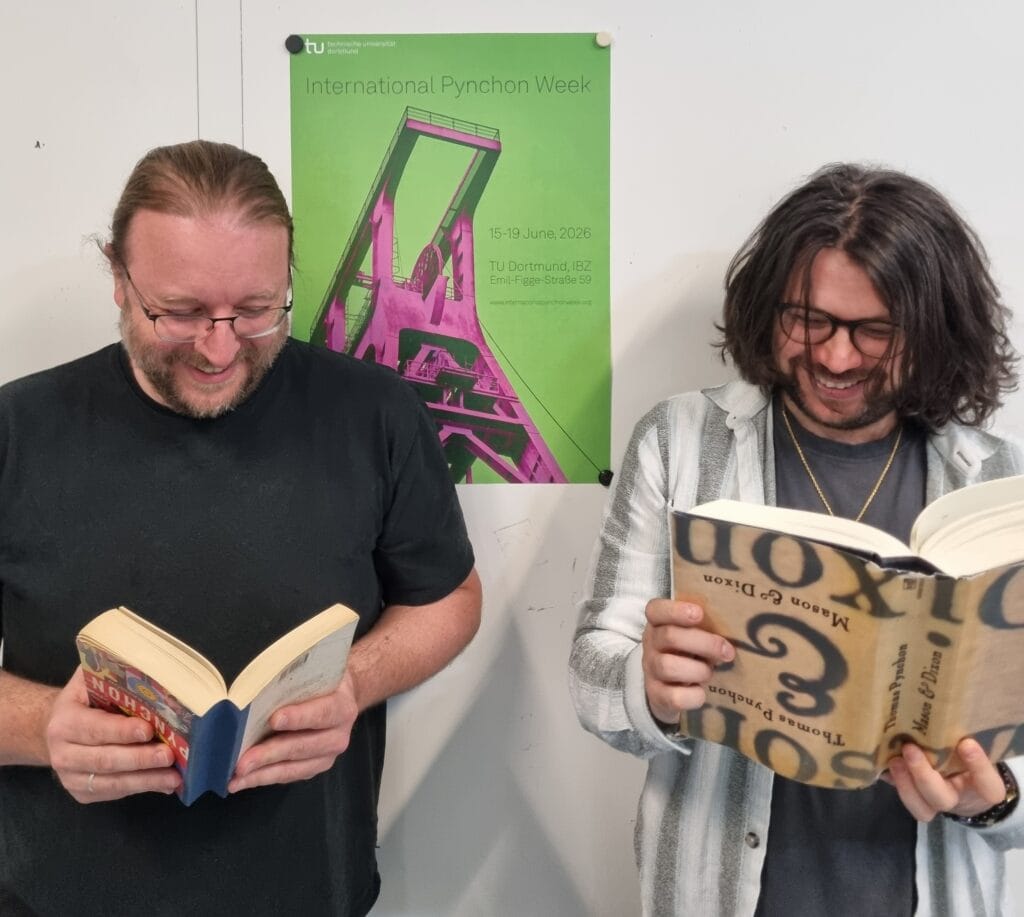
“‘Consider coal and steel. There is a place where they meet. […]'” (Thomas Pynchon in Gravity’s Rainbow (1973/1995: 166)) – thus Sascha Pöhlmann and Burak Sezer’s introduction to their invitation to the International Pynchon Week 2026 (cf. Pöhlmann and Sezer 2026a), June 15-19, in Dortmund, Germany, formerly part of the heartland of the German coal industry.
Keeping up with the biannual tradition of International Pynchon Weeks (IPW) the American Studies Institute at the Technische Universität Dortmund, hosts this year’s conference of Pynchon scholars – while, once again, also more or less keeping in line with tradition, a soccer event takes place – this time the FIFA World Cup – in Thomas Pynchon’s home country.
If you are interested, you can listen to 36 presentations by Pynchon scholars – starting on Monday with former IPW organizer Hanjo Berressem (IPW 2002) on “Pynchon’s light” and closing with Visit playing songs from Pynchon’s works on Friday night at domicil in Dortmund.
The conference program includes deep dives into aspects of Pynchon’s short stories and novels, among them “Under the Rose” (1961), V. (1963), Gravity’s Rainbow (1973), Vineland (1990), Against the Day (2006), Inherent Vice (2009), Bleeding Edge (2013), and Pynchon’s most recent novel Shadow Ticket (2025).
Some Pynchon scholars take a broader view and present papers on Pynchon in translation, bibliographies and guides, conspiracy theories, violence, and many other aspects. The schedule on Thursday (June 18) closes with a plenary discussion on teaching Pynchon.
Interviewing the organizers of the IPW
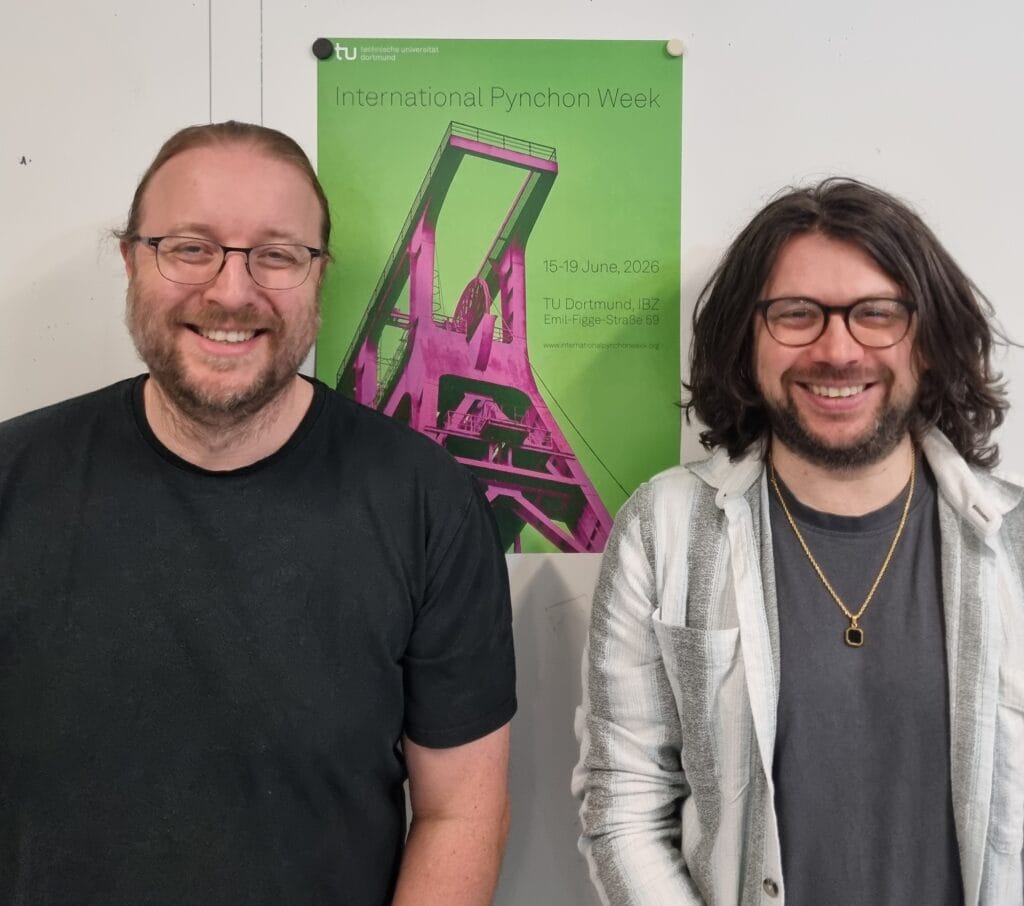
Again, I do owe a deep gratitude to the organizers of the International Pynchon Week, Sascha Pöhlmann (also IPW organizer in 2008) and Burak Sezer. Both have helped keep this tradition alive: Asking the hosts of the upcoming IPW about their personal life with “Pynchon” as well as about organizing an IPW.
For simplicity’s sake and in order to easily compare answers by all organizers of the IPW so far, I have sticked to the questions I had first asked Umberto Rossi and Paolo Simonetti before their International Pynchon Week in Rome (2019).
Thanks to Sascha and Burak, since 2026 there is also a new compilation of anecdotes on former IPWs. They asked IPW alumni organizers to reminisce: What are their recollections and reflections of the week they organized?
In addition to the chronology of IPWs below therefore make sure to read: A Brief History of the International Pynchon Week (Pöhlmann and Sezer 2026b).
Chronology of International Pynchon Weeks et al.
Additionally, you can find my updated list of conferences on Pynchon below. Not all of them were called “International Pynchon Week” and there have definitely been more Pynchon conventions than those I have listed so far.
If you can think of anything to add to the list (other IPWs, conference title, names of organizers, and possibly publications of contributions), feel free to let me know – simply by commenting on this blog entry at the end of the blog post or by shooting me an email, e. g. via the Contact Form.
| Year | Location | Date | Title |
|---|---|
| 1994 | Warwick, England (November): Schizophrenia and Social Control – organized by Eric Cassidy and Dan O’Hara |
| 1998 | Antwerp, Belgium (June): Gravity’s Rainbow: The First 25 Years – organized by Luc Herman – proceedings to the conference in Pynchon Notes, nos. 42-43 London, England (June): Beyond the Rainbow’s End – organized by Eric Weinstein – articles in Abbas 2003 |
| 2000 | Nordhausen – Babelsberg – Greifswald – Peenemünde (19-23 June): Into the Zone / Gravity’s Rainbow and Geography – organized by Bruno Arich-Gerz – articles in Pynchon Notes, nos. 50-51 |
| 2002 | Cologne, Germany (14-16 June): site-specific: from aachen to zwölfkinder – pynchon | germany – organized by Hanjo Berressem – articles in Pynchon Notes, nos. 54-55 |
| 2004 | Valletta, Malta – organized by Vaska Tumir |
| 2006 | Granada, Spain – organized by Celia Wallhead – proceedings to the conference in Pynchon Notes, nos. 56-57 |
| 2008 | Munich, Germany (June 11-14): Against the Grain: Reading Pynchon’s Counternarratives – organized by Sascha Pöhlmann – proceedings published in Pöhlmann 2010 – newspaper report in Die Welt (German newspaper) – report by Bruno Arich-Gerz (on electronic book review) |
| 2010 | Lublin, Poland: Of Pynchon and Vice: America’s Inherent Others – organized by Tomek Basiuk, Paweł Frelik, and Zofia Kolbuszewska – proceedings published in Kolbuszewska 2012 |
| 2013 | Durham, England – organized by Martin Paul Eve and Sam Thomas – report by Martin Paul Eve on the conference: Eve 2013 |
| 2015 | Athens, Greece – organized by Georgios Maragos |
| 2017 | La Rochelle, France – organized by Gilles Chamerois and Bénédicte Chorier-Fryd |
| 2019 | Rome, Italy (11-14 June): Pynchon in Rome – organized by Giorgio Mariani, Umberto Rossi, and Paolo Simonetti – official website – Reading Pynchon interview on the IPW 2019 with Umberto Rossi and Paolo Simonetti – Pynchon in Rome – blog article on the IPW 2019 on Reading Pynchon |
| 2021 | Vancouver, Canada – did not take place due to the COVID-19 pandemic |
| 2022 | Vancouver, Canada (6-10 June) – organized by Jeff Severs – Reading Pynchon interview on the IPW 2022 with Jeff Severs – The International Pynchon Week 2022 – blog article on the IPW 2022 on Reading Pynchon |
| 2024 | Belgrade, Serbia (17-21 June) – organized by Sergej Macura and Aleksandra Vukotić – Reading Pynchon interview on the IPW 2024 with Sergej Macura and Aleksandra Vukotić |
| 2026 | Dortmund, Germany (15-19 June) – organized by Sascha Pöhlmann and Burak Sezer – official website – newspaper report in nd (German newspaper) by Chris W. Wilpert |
The organizers of the International Pynchon Week 2026
Who are Sascha Pöhlmann and Burak Sezer, the organizers of this year’s International Pynchon Week?
With regard to their academic career, at the time being, both are faculty members of the Department of American Studies at the Technische Universität Dortmund. Not surprisingly here, their research interests include, among other aspects of American culture, Thomas Pynchon’s works – I recommend the following monographs, editions, and essays:
- Sascha Pöhlmann (2010). Pynchon’s Postnational Imagination, Heidelberg: Universitätsverlag Winter.
- Sascha Pöhlmann (ed.; 2010). Against the Grain: Reading Pynchon’s Counternarratives, Rodopi.
- Burak Sezer (2021). “Going West, Slow and Fast. Speed and Surveying in Thomas Pynchon’s Mason & Dixon“, in: Alexandra Ganser, Leopold Lippert, Helena Oberzaucher, and Eva Schörgenhuber (eds.). JAAAS: Journal of Austrian Association for American Studies 3(1), 99-119.
- Burak Sezer (to be published). After Maths: Thomas Pynchon’s Poetics of Mathematics, doctoral dissertation project, a.r.t.e.s. Graduate School for the Humanities, Cologne.
Now go ahead and read what Sascha Pöhlmann and Burak Sezer have to say about their “personal Pynchon” and about organizing the International Pynchon Week 2026!
Interview with Sascha Pöhlmann and Burak Sezer
On Pynchon and his works
Reading Pynchon: What was the first Pynchon novel you read? What were your experiences with that text?
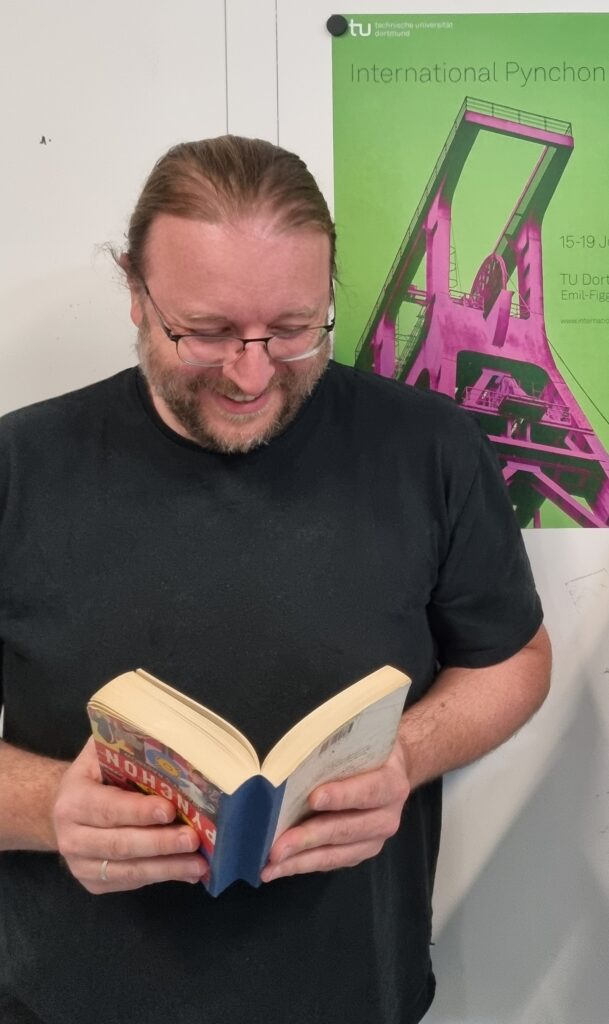
Sascha Pöhlmann: It was Gravity’s Rainbow. I bought it used for £3,99 in Kilkenny when I was traveling through Ireland with my aunt and uncle. At the time I fancied myself a Joycean; I studied at Trinity College Dublin only to take classes on Joyce, and I wouldn’t shut up about Ulysses being the best novel ever, as I really did think I would never read anything like it, or better. I started reading Gravity’s Rainbow in bed that night, and after just a few pages I thought, huh, what do you know. It was one of those very rare reading experiences where you feel that you will never stop reading this, and that’s how it was. I ended up writing my MA thesis on Ulysses and Gravity’s Rainbow and my dissertation on Gravity’s Rainbow and Mason & Dixon, and so I made the transition to a full Pynchonite after all.
Burak Sezer: I distinctly remember – that was The Crying of Lot 49 (that’s the novel everyone teaches because it’s by far the shortest). I was an undergraduate still, and I remember that it was quite beyond me and I couldn’t understand what was going on. But certain episodes and scenes stuck with me – for example his comparison between the work of a mail deliverer and Maxwell’s demon. And every once in a while, I caught myself chucking, and funnily enough, I laughed even harder during my second reading of that novel years later – it’s easier to get the jokes.
Reading Pynchon: What do Pynchon’s novels mean to you?
Sascha Pöhlmann: They’re my favorite pieces of literature, that’s what. Yes, Ulysses does get an honorable mention here, as should about a dozen others I wouldn’t mind taking to that desert island, but as a full set of nine novels published across six decades that are very different but still have a very recognizable style, they are absolutely unique. I read them for fun, and teaching them and writing about them professionally is just as much fun.
Burak Sezer: I wrote my dissertation exclusively on Pynchon’s novels, so they are very dear to me. They mark that transition from being a playful and interested student to being a more serious and dedicated researcher. I still have all of my copies that I used at that time, and the comments I wrote on the margins really take me back in time, and it’s really interesting for me to see what I thought would become important in the heat of the moment (you could tell where I was exceptionally excited) and what actually made it into my writings – 90%, I guess, had to be left out.
Reading Pynchon: Which Pynchon novel or short story is your most favorite one today? Please, explain why.
Sascha Pöhlmann: It’s still Gravity’s Rainbow, my first love, and most Pynchonites would probably say that. The humor, the complexity, the madness of it all in a text, I swear, keeps changing with every re-reading – that’s just exactly what I love about reading. But Mason & Dixon is a very close second, and it’s one of the few novels that made me cry. And I have a soft spot for Bleeding Edge, which doesn’t get enough love (as does Vineland). And I keep forgetting how good V. is until I read it again. And so on …
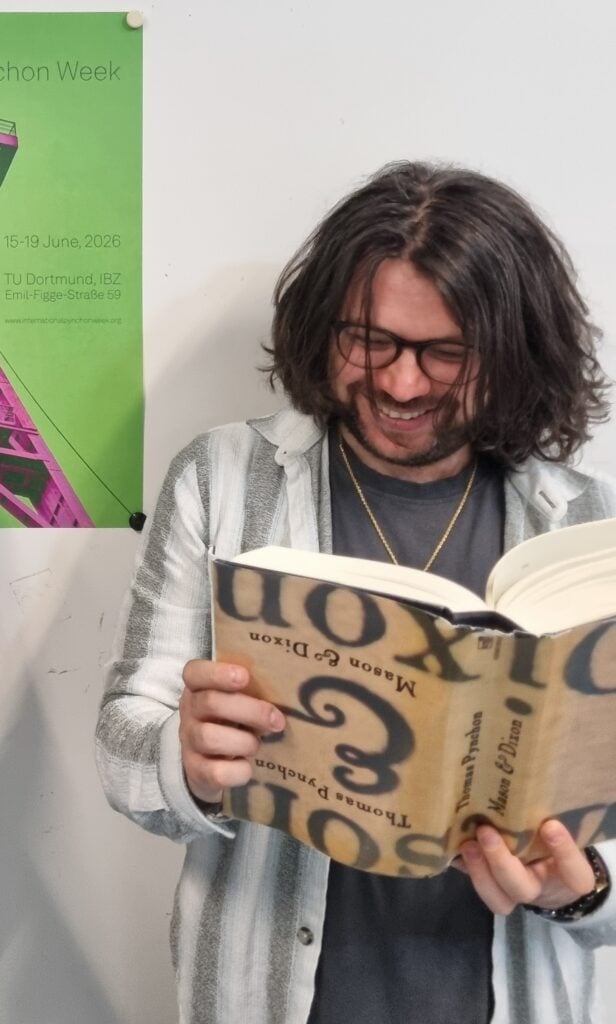
Burak Sezer: It’s difficult, but it’s probably Mason & Dixon. There is some magic in that novel that is so difficult to describe. The number of meticulously researched facts to be featured in the novel is staggering – and the truly mind-boggling part is that it never feels overloaded or pretentious, even though it’s so full on every page. Every sentence hits really hard. Everything feels like it truly belongs. Also, I cried my eyes out at the very end, because for me this has been the novel of his Big Three (alongside Gravity’s Rainbow and Against the Day) which featured protagonists with whom I could empathize so effortlessly. But I need to mention the final three pages of Gravity’s Rainbow, too. The final scene is so out of this world – that one, however, evoked feelings of awe in a way I never experienced in literature – but it’s got to be Mason & Dixon still.
Reading Pynchon: What aspect of Pynchon’s literary work are you most interested in? In other words: If you had the time and means to write a (new) book on Pynchon – what aspect of his works would you focus on?
Sascha Pöhlmann: The last talk I gave at an International Pynchon Week (in Belgrade in 2024) was on the public and the private in Mason & Dixon, and that binary would provide an excellent framework for an analysis of all his novels and even short stories (“The Secret Integration”!). How do these texts imagine privacy and the public sphere and their interrelation? How does this relate to individual and communal political action in them, and to surveillance and control? How does all this coincide with the progress of Modernity from the Enlightenment to now? And how does it relate to the familiar stuff the Pyndustry has been preoccupied with for a while, such as paranoia, conspiracy, etc.? That’s what I would write.
Burak Sezer: Even though my book on Pynchon’s mathematics will come out soon, I feel I have not exhausted what I wanted to say – so I’ll probably do some work on that in the future. But I’d also like to see Pynchon’s trademark paranoia and conspiratorial spin re-calibrated in the face of recent news on actual confirmed global conspiracies and the surging hegemony of Big Tech. It feels like we will join Pynchon in using the third person plural pronoun “They” way more often to describe the goings-on in our lives and politics.
Organizing the International Pynchon Week 2026 in Dortmund
Reading Pynchon: Please tell us about your hopes and expectations for the International Pynchon Week 2026 in Dortmund.
Sascha Pöhlmann: I hope and expect that this International Pynchon Week will continue the great tradition of these conferences in one particular aspect that comprises quite a few others: If I had to summarize Pynchon Weeks in one word, it would be generosity. Not in terms of inviting people to fancy conference dinners – we don’t do that – but in terms of how everyone is eager to share what they know, and how there has never been a difference between keynote speakers and others or full professors and undergrads. Everyone gets their 30 minutes on a panel. And everyone will get questions and comments that may well be challenging or blunt, but I have never witnessed any of them offered in anything but a spirit of constructive critique. I hope it will be an event where everyone will feel at home.
Burak Sezer: To see all of our friends and colleagues again after two years is really wonderful – I guess I hope that, after all the organizing in the past weeks, the actual conference will just proceed effortlessly – and, of course, that I can find the time to enjoy some of the papers. But the Pynchon crowd is an easy-going one anyways, so the chances are quite high!
Reading Pynchon: In what sense do the speakers’ contributions to the International Pynchon Week offer new insights into or new readings of Pynchon’s works?
Sascha Pöhlmann: The easy answer is that it’s the first conference after the publication of Pynchon’s latest novel to date, Shadow Ticket, so we’ll hear quite a few talks about that. But we’ll also continue a relatively new trend in Pynchon Studies that began at Belgrade, and that is considering Pynchon in translation and in various local contexts more. And we will surely continue an ongoing discussion of what it means to read novels about the threat of American fascism in times when this is no longer mainly the domain of fiction.
Burak Sezer: There has been a new novel – Shadow Ticket – which is quite some news, given that his latest one was Bleeding Edge, and that one was published in 2013! So the past IPWs did not have the rejuvenating aspect that a new novel would bring to the table, which makes it all the more exciting this year.
Reading Pynchon: Could you tell us about your experiences when organizing the International Pynchon Week?
Sascha Pöhlmann: I’ve done it once before, in Munich in 2008, so I can speak to that experience as well as this one. It’s absolutely fantastic, and it comes down to the aforementioned generosity again. Organizing a conference is mainly communication work, and writing all these e-mails and getting in touch with people has been nothing but wonderful. It’s like hosting a party whose guests are actually eager to attend, and that’s easy. And we’re especially thrilled to conclude the conference with a free concert at domicil in Dortmund, where Visit will play their wonderful songs from Pynchon’s novels, with Jack Campbell performing one of his own compositions inspired by Pynchon’s works, and with our local heroes Ariana Sheikhi and Lisa Schnickmann opening.
Burak Sezer: It’s by far the largest conference that I ever co-organized, but Sascha’s skill and handling of many of the technicalities, such as setting up a homepage or involving some of the old Pynchonites, have led to nothing but smooth sailing so far. No really major hiccups at all!
Reading Pynchon: Where will the next International Pynchon Week take place?
Sascha Pöhlmann: We certainly don’t get to announce this, and this question usually gets sorted out at every conference, but there has been talk about Aarhus in Denmark in 2028, which would be fantastic. Watch this space and www.internationalpynchonweek.org and you’ll find out!
Burak Sezer: As always, we will decide together in Dortmund. But there’s a strong contender for 2028 – and it doesn’t seem to be too far away from Dortmund, which is great!
Reading Pynchon: Thanks a lot for the interview!
Further Reading
- Abbas, Niran B. (2003; ed.). Thomas Pynchon: Reading from the Margins, Madison, N. J.: Fairleigh Dickinson University Press.
- Eve, Martin Paul (2013). “On International Pynchon Week”, URL: https://eve.gd/2013/08/11/on-international-pynchon-week/ and here: https://readdurhamenglish.wordpress.com/2013/08/14/on-international-pynchon-week-2013/ (Last access: 30 May, 2026).
- Kolbuszewska, Zofia (2012). Thomas Pynchon and the (De)vices of Global (Post)modernity. Wydawnictwo KUL.
- Pöhlmann, Sascha (2010). Pynchon’s Postnational Imagination, Heidelberg: Universitätsverlag Winter.
- Pöhlmann, Sascha (ed.; 2010). Against the Grain: Reading Pynchon’s Counternarratives. Rodopi.
- Pöhlmann, Sascha and Burak Sezer (ed.; 2026a). International Pynchon Week 2026. June 15-19, 2026, URL: https://anglistik.kuwi.tu-dortmund.de/ipw26/ (Last access: May 30, 2026).
- Pöhlmann, Sascha and Burak Sezer (ed.; 2026b). A Brief History of the International Pynchon Week, URL: https://anglistik.kuwi.tu-dortmund.de/ipw26/ (Last access: May 30, 2026).
- Pynchon, Thomas (1973/1995). Gravity’s Rainbow, paperback edition from 1995, New York et al.: Penguin Books.
- Sezer, Burak (2021). “Going West, Slow and Fast. Speed and Surveying in Thomas Pynchon’s Mason & Dixon“, in: Alexandra Ganser, Leopold Lippert, Helena Oberzaucher, and Eva Schörgenhuber (eds.). JAAAS: Journal of Austrian Association for American Studies 3(1), 99-119, URL: https://jaaas.eu/index.php/jaaas/article/view/58 (Last access: 30 May, 2026).
- Sezer, Burak (to be published). After Maths: Thomas Pynchon’s Poetics of Mathematics, doctoral dissertation project, a.r.t.e.s. Graduate School for the Humanities, Cologne.
Credits
- Featured image for the blog post: International Pynchon Week 2026 © Sascha Pöhlmann, TU Dortmund and Utz Klöppelt – Reading Pynchon
- Sascha Pöhlmann and Burak Sezer, 2026 © Sascha Pöhlmann and Burak Sezer
- Sascha Pöhlmann reading Pynchon © Sascha Pöhlmann
- Burak Sezer reading Pynchon © Burak Sezer
- Conference poster IPW 2026 © Sascha Pöhlmann, TU Dortmund
- IPW 2026 organizers reading Pynchon © Sascha Pöhlmann and Burak Sezer